- The Supply Times
- Posts
- Bitcoin Down 40% and Searching for Purpose
Bitcoin Down 40% and Searching for Purpose
The Supply Times Issue #94

Naseem Malik
February 26, 2026

Hello, dear readers!
Bitcoin had everything it supposedly wanted. A pro-crypto administration, spot ETFs pulling in institutional money, and deeper Wall Street integration… yet the crash still came. With 40% (or around $1 trillion) wiped since October, economists are starting to write Bitcoin’s obituary. But we’ve been here before.
Also, as AI continues to replace white-collar jobs, how will America’s knowledge workers be reallocated? In the best-case scenario, they’ll contribute more to the economy through creative and strategic work. But in the worst case, they might spend their days on video games and sports betting… essentially contributing nothing. Read more below.
This issue features the usual bunch of AI Insights and recommendations for the week's podcasts, books, shows, charts, and tweets, followed by a final chuckle.
Let’s get going.

Industry Highlights: Bitcoin Crashed Despite Having Everything It Wanted
Bitcoin's sitting in a rough spot right now, down more than 40% from its all-time high of $126,000–$127,000 in October 2025. As of late February 2026, it's hovering in the mid-to-high $60,000s to low $70,000s range. That drop has wiped out over $1 trillion in market cap from its peak, turning what looked like an unstoppable bull run into a brutal reality check.
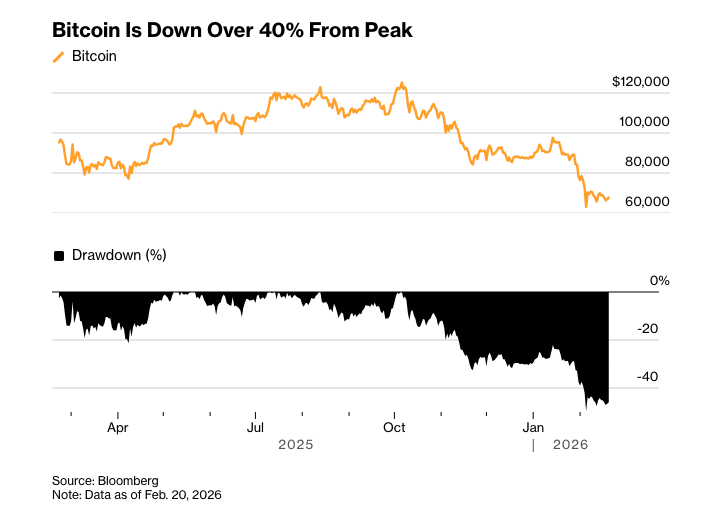
Bitcoin has been through this kind of wreckage before. Multiple times. Think back to the 2017–2018 crash when it plummeted over 80% from nearly $20,000 to under $4,000. Or the 2022 bear market, where it tanked from $69,000 to below $16,000 after the FTX blowup and everything else. Each time, the “Bitcoin is dead” obituaries piled up, and yet here we are, still talking about it. The network kept hashing, holders kept holding (or buying the dip), and new highs followed eventually. History shows these massive troughs are part of the ride rather than the end of it.

But this time feels different. Bitcoin had everything it supposedly wanted. Pro-crypto vibes out of Washington, spot ETFs pulling in institutional money, deeper Wall Street integration, even companies treating it like a treasury asset. But the price action? Not cooperating. The usual rebound triggers, like a dip-buying frenzy or macro hedges kicking in, aren't firing. Instead, gold is stealing the "safe haven" spotlight amid whatever chaos is brewing geopolitically. Stablecoins are dominating actual payments. And for pure speculation? Folks are chasing dopamine hits on prediction markets like Polymarket or Kalshi, where you bet on real-world events with quick resolutions and no need for crypto's wild swings.
The core issue boils down to purpose. Bitcoin's value has always been narrative-driven: digital gold, freedom money, inflation hedge, the ultimate scarce asset with its 21 million cap and halvings. Those stories powered the "number go up" era. But when the number goes down (and stays down), the faith wavers.
Then there's the financialization angle. Bitcoin's gone from underground rebellion to just another ticker on brokerage apps, complete with leveraged derivatives, volatility products, and ETF wrappers. That accessibility helped it go mainstream, but it also stripped away some of the magic. The scarcity is real, but attention isn't. There's infinite competition now: altcoins, tokenized everything, structured products. Even distant worries like quantum computing nibble at the edges of its crypto security narrative.
Outflows tell the story: spot Bitcoin ETFs have seen billions leave recently, while gold ETFs rake it in. Corporate Bitcoin treasuries? Some are trading below their holdings' value now, flipping the old self-reinforcing loop into a vicious one.

Still, don't count it out. Bitcoin's has survived worse and come back swinging. The network's resilient, liquidity's deep, and regulatory tailwinds (even if they're boosting stablecoins more right now) could lift the whole space. Bulls argue it's just cycling through another crisis of confidence, and history favors the survivors.
Is this a temporary gut-check or something more permanent? That's the trillion-dollar question.

The Future of Work: The Challenge of Reallocating Talent in an AI-Driven Economy
American finance veteran-turned-thinker Byron Gilliam poses a cautionary, but not doom-laden, question: as artificial intelligence redefines what work looks like, will working-age people contribute more to the economy, or will they drift into less productive hobbies like video games and sports betting? The answer, he suggests, hinges on how societies redirect talent, not merely on what machines can do.

Gilliam begins with a story from his time on a trading floor in 2007. New joiners (sometimes with advanced degrees in chemistry or nuclear physics) performed tasks that felt incongruent with their training, like creating PowerPoint decks about structured derivatives.
That misallocation, he argues, foreshadowed a broader pattern in which economic growth could stall if talent is not redirected toward higher-value activities. The key, he writes, is what happens when labor is freed from lower-value tasks: does the liberated time translate into productivity gains or into wasted opportunities?
The Knowledge Economy’s Washing Machine
History provides a lens for this question. Gilliam points to the agricultural revolutions and the rise of factory work, where innovations like crop rotation and mechanization released labor to produce more, not less.
The invention of the washing machine, he notes, is another touchstone: Hans Rosling wrote an account of its societal ripple effects, including giving a mother more time to read to her child and shape a future physician.
In Gilliam’s view, analogous transformations could unfold today with AI, which he envisions as the knowledge economy’s “washing machine.” If AI handles boilerplate coding, debugging, and other routine tasks, engineers and knowledge workers could pivot to higher-value work: creative problem-solving, design, strategic planning, and cross-disciplinary innovation.
The debate is far from settled. Gilliam surveys divergent economic forecasts. Some, like Adair Turner, warn that rapid automation could spawn a wave of low-productivity activities and real consumption gains that never materialize in GDP statistics. The question becomes: if people have more discretionary hours over their lifetimes, how will they put them to use?

Others, notably David Autor, argue that automation raises the demand for labor in tasks that machines cannot replicate; areas requiring adaptability, creativity, and nuanced judgment. Gilliam leans toward the latter view but remains mindful of practical realities: workers do not switch careers effortlessly, and the path from automation to broad-based productivity gains is uneven across sectors and regions.

Will AI steer more people toward socially productive ends or toward leisure-imbued pursuits? Gilliam suggests that the outcome is not determined by technology alone but by policy choices, education systems, and the willingness of firms to reallocate talent into fields with high social and economic returns: materials science, clean-energy engineering, healthcare innovation, infrastructure, and more.
He imagines a world where some displaced software engineers move into roles that address pressing societal needs, such as carbon capture or energy efficiency, rather than chasing the next ad-impression payoff.
Gilliam’s piece poses a question for policymakers, business leaders, and workers alike: if AI frees people from repetitive work, will the excess cognitive capital propel the economy forward, or will it default to less productive pastimes? The mood of the argument is cautiously optimistic, but the trajectory remains dependent on deliberate choices about education, job design, and investment in transformative sectors.
AI Insights

Pika Labs unveiled AI Selves, a digital-twin concept in which users birth, raise, and deploy autonomous AI extensions that possess persistent memory and adapt to the user’s personality across platforms. The company positions these AI Selves as living extensions rather than chatbots, capable of actions like sending photos, creating games, and performing tasks on the user’s behalf. Some commentators tie the release to the broader “dead internet” theory, which argues that much online content is being generated or amplified by automated systems.
Anthropic accuses Chinese AI of distillation attacks: Anthropic says three Chinese AI labs—DeepSeek, Moonshot AI, and MiniMax—conducted “industrial-scale” distillation campaigns against its Claude models to siphon advanced capabilities. It cites roughly 24,000 fraudulent accounts and over 16 million exchanges used to extract Claude’s features, noting the timing coincides with Washington’s debate over AI chip export controls to China.
The 2028 Global Intelligence Crisis is a thought exercise by Citrini Research. It argues that AI could trigger an intelligence displacement spiral by 2028, unleashing mass white-collar displacement, collapsing consumer spending, and undermining core pillars of society—labor, housing, and government. The twist here is that the authors aren’t imagining a society where AI has gone wrong. This scenario is modelled around a future where AI is working exactly as planned.
The Supply Aside
📕 Read - Don’t Tell The President

Every seamless campaign appearance and presidential trip rests on the meticulous work of event planners and advance teams, who transform political logistics into carefully choreographed performances. But things often go hilariously wrong. Don’t Tell The President retells many of these stories, from Dukakis looking silly in a tank to Chelsea Clinton being accidentally left behind in Moscow. I’m a fan of the author Jean Becker as she wrote a great book on Bush 41 a couple of years ago.
What Else I’m Reading
The dial has barely shifted for female CEOs: A Financial Times analysis shows the share of female chief executives in the FTSE 100 has barely moved over five years, rising from eight in 2021 to nine in 2025, with several prominent women exiting and being replaced by men. The piece attributes the stagnation to weak succession planning, a damaged executive pipeline, and ongoing biases and pressures.
Prediction markets are booming: Platforms like Polymarket and Kalshi let people place bets on real-world events, from what the Federal Reserve will say to election outcomes. These markets are drawing big investments and new partnerships, but they also face legal battles, regulatory scrutiny, and worries about accuracy and possible manipulation.
OpenAI partners with big consultants: OpenAI is signing multiyear partnerships with Accenture, Boston Consulting Group, Capgemini, and McKinsey to accelerate adoption of its Frontier enterprise platform. The consulting firms will help enterprise customers shape AI strategy and deploy AI agents into real production workflows at scale.
📺 Watch - The Alabama Solution

The U.S. has nearly the highest incarceration rate in the world, and certainly the highest in the developed world, with somewhere between 580 and 614 people per 100,000 imprisoned. As of 2025, that meant nearly 2 million incarcerated individuals out of our population of 343 million.
This being the case, it’s important that we all have some idea of what’s going on inside our behemoth prison system.
The Alabama Solution hits hard and stays with you, told straight from inside the system by the people leading the charge: Robert Earl Council and Melvin Ray of the Free Alabama Movement. Shot largely in prisons over six years and using footage smuggled out by inmates, it lays bare a world of overcrowding, abuse, and stubborn neglect, then follows the human cost, including the death of Steven Davis, into a louder call for change. Directed by Andrew Jarecki and Charlotte Kaufman, it debuted at Sundance in January 2025 and landed on HBO later that year, earning praise for its unflinching honesty and urgent mood.
While we’re talking about prison exposés, be sure to check out Shane Bauer’s gripping story of his four months spent undercover as a private prison guard. Perhaps the best piece of investigative journalism I’ve ever read.
👂 Listen - Acquired podcast: The NFL

NFL Commissioner Pete Rozelle, 1970
The NFL has become a symbol of American culture itself. Few things feel more quintessentially American. It generates more revenue than any other sports league worldwide and routinely shatters valuations records, yet this rise did not happen in a vacuum. The league’s arc closely tracks the country’s own evolution: resourceful, small-town outfits rode wave after wave (television, the Internet, and social media) to outgrow even the founders’ boldest dreams. Whether you’re a fan or not, the NFL stands as an extraordinary business saga.
🧠 Think: The Deep Freeze
Remember the Great Resignation? That era is officially dead.
If you needed proof the job market is frozen, here it is. Turnover just hit 5.8% in January. According to ADP, that is the lowest level in nine years.
That is not stability. That is paralysis.
When hiring slows, people stop jumping. The standstill is particularly pronounced in white-collar roles such as finance and professional services. Back in 2021, companies were throwing out hefty raises. Today, everyone is just holding onto their current chair.
Here is the "so what" for leaders: Your retention strategy worked, but your talent pool is now stagnant. The normal push and pull of hiring have stalled. No one is leaving, so no one is bringing in fresh ideas.
When teams feel stuck, innovation tends to stall. Be careful what you wish for.
Charts of the Week


Quote of the Week
“The detective story differs from every other story in this: that the reader is only happy if he feels a fool."
- G.K. Chesterton
Tweet of the Week

The Final Chuckle

Image: Global Times
|

Thanks so much for reading. I’d love to know what you think about this issue and how I can make it more useful to you. If you have suggestions or topics you want to see me address, email me at [email protected]!
-- Naseem